Correspondence and notices
A clear fixed identity supports letters and documents that are mailed, handed over or retained.
LETTERHEADS
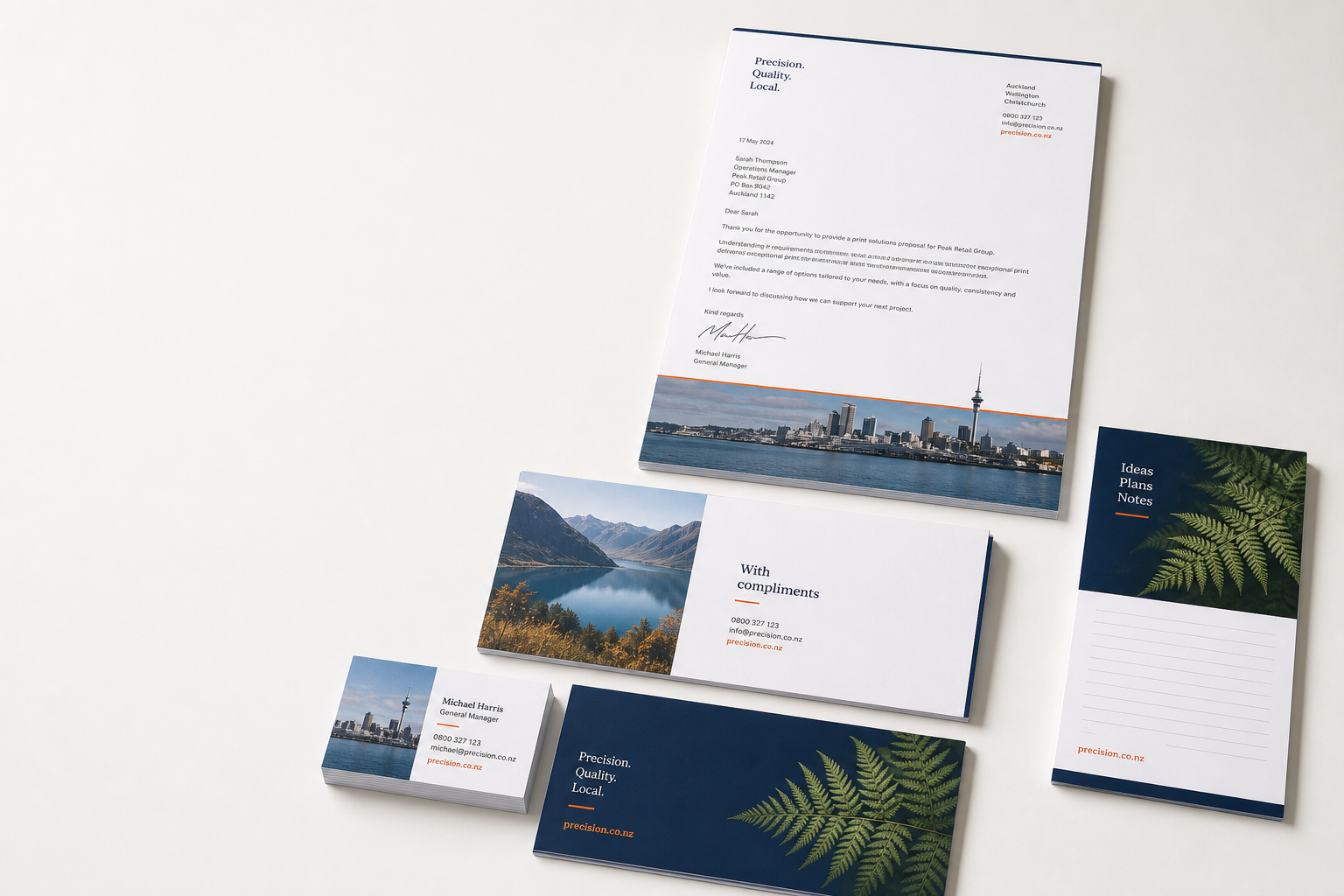
Printed letterheads put your logo and contact details on the paper used for letters, quotations and other business documents. The rest of the sheet stays clear for the message, signature or form. If you will add the text with an office printer, its paper requirements need to be considered when choosing the stock.
WHERE LETTERHEADS FIT
Mailing, signing, handing over and filing place different demands on a sheet from sending a PDF alone.
A printed letterhead is useful for correspondence that leaves the office as paper, documents that need a signature, forms completed by hand and material placed into a proposal or customer pack. It keeps the organisation’s fixed details in place while the changing content is added for each recipient.
Some letterheads pass through an office printer; others are written or signed on by hand. The paper needs to suit that use, and the printed design needs to leave room for addresses, body text and signatures. Fastprint can consider the stated printer and writing requirements when quoting the sheet.
Consistency is part of the benefit. A current logo, contact block and approved organisation details appear in the same place across correspondence, quotations and notices, while staff concentrate on the content that changes. That can make a physical document feel established without turning the top of every page into an advertisement.
A clear fixed identity supports letters and documents that are mailed, handed over or retained.
Changing customer or job information sits within a consistent business page.
A usable writing area and suitable surface matter when information is added by hand.
WHAT QUALITY LOOKS LIKE
Letterhead design works best when fixed information is sharp, current and easy to recognise, but the document still has room to do its job.
A strong letterhead has a clear logo, readable contact details and enough quiet space for dates, addresses, headings, signatures and body copy. Paper choice should suit the way the sheets will be printed, written on, folded, mailed and filed. Printing on the reverse can be useful, but only when it serves a recurring purpose rather than filling an empty surface.
Small errors carry through an entire run, so current addresses, phone numbers, email details and any organisation information deserve the same attention as the logo. Separate office or department versions can share a layout while keeping their own correct details and quantities.
Fastprint confirms the sheet specification, printed sides, artwork versions and stated office-printer requirement with the quote before production details are settled. The artwork is checked against the intended product, and quote and proof approval take place before production begins. The proof also gives you a chance to check phone numbers, addresses and other fixed details before they repeat through the print run.
The logo and contact information remain readable without dominating the page.
Document templates, signatures and handwritten notes have enough uninterrupted space.
The paper can be considered against stated printer, writing, folding and mailing requirements.
Every office or department version carries the correct approved details.
GET A QUOTE
Send the current artwork and describe how the sheets will be used after delivery. Include the sheet size, printed sides, quantity for each artwork version, office-printer type or other handling requirement, destination and required date. Stock can remain open if guidance is needed.